

What Comparisons Does Bacon Draw Between Studies And Physical Excercise
Exercise: A healthy stress reliever
When information technology comes to good health, concrete activity matters. Exercise and physical activity improve overall fitness, body mass alphabetize, and cardiovascular and muscular health.1 Studies even testify exercise can salve stress, reduce low and ameliorate cognitive role.2,iii,4
Although many respondents to the Stress in America™ survey report that they feel positive benefits from do, such as feeling practiced about themselves, beingness in a proficient mood and feeling less stressed, few say they make the fourth dimension to do every day. In fact, the survey found that more than one-tertiary of adults (37 per centum) written report exercising less than one time a week or not at all.
Only 17 percentage of adults report exercising daily.
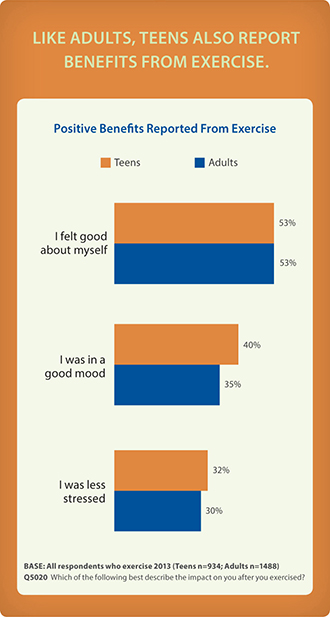
Fifty-three percentage of adults say they feel adept virtually themselves after exercising, 35 percent say it puts them in a expert mood and 30 percent say they feel less stressed.
Fewer than half (43 percent) of adults say they do to manage stress and 39 per centum say they accept skipped exercise or concrete activeness in the past month when they were feeling stressed.
Sixty-2 per centum of adults who say they practise or walk to help manage stress say the technique is very or extremely effective. Forty-three pct of adults who study exercising specifically to help manage stress say they skipped exercise or concrete activity in the past month when they were stressed.
Half of adults (fifty per centum) say that being physically active or fit is extremely or very important to them, yet only 27 percent written report doing an fantabulous or very good job of achieving this.
Like adults, teens also report benefits from practice, only face up challenges when information technology comes to being physically active or fit.
Fifty-three percent of teens say they feel good well-nigh themselves later exercising, 40 percent say it puts them in a expert mood and 32 per centum say they feel less stressed after exercising. Regardless, one in five teens (twenty percent) report exercising less than one time a week or not at all.
30-seven percent of teens say they do specifically to manage stress.
Threescore-eight percent of teens who say they exercise or walk to assistance manage stress say the technique is very or extremely effective.
Twenty-eight percent of teens skipped exercise or physical activeness in the by calendar month when they were feeling stressed and 37 per centum of teens who report using do to manage stress say they skipped practise or concrete activity in the past month when they were stressed.
The majority of teens (62 percent) say that beingness physically active or fit is extremely or very important to them, yet only 51 percent report doing an excellent or very good job at achieving this.
 Millennials are more than likely than other generations to say they exercise weekly and recognize the positive benefits of doing so.five Despite this, many Millennials yet report skipping exercise considering of stress.
Seventy-2 percent of Millennials say they do one time a week or more, compared with 59 pct of Gen Xers and Boomers and 56 percent of Matures.
Millennials are likewise more likely to report feeling less stressed afterwards exercise (36 percent vs. 31 per centum of Gen Xers, 28 percent of Boomers and sixteen per centum of Matures) and to say they exercise or walk to manage stress (l pct vs. 44 percent of Gen Xers, forty percent of Boomers and just 36 per centum of Matures).
Notwithstanding, Millennials are more likely to say that they take skipped exercise or physical activity in the by month when stressed (52 per centum vs. 41 percent of Gen Xers, 33 percentage of Boomers and 18 percent of Matures).
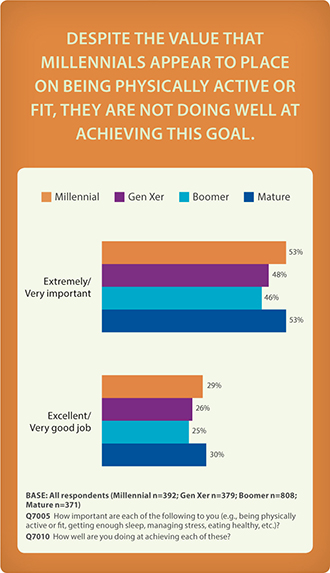
Despite the value that Millennials announced to place on being physically active or fit, they are not doing well at achieving this goal: 53 per centum say it is very or extremely important to them, yet only 29 percent say they are doing an excellent or very good job at information technology. Comparatively, 53 percentage of Matures, 48 percent of Gen Xers and 46 per centum of Boomers say existence physically agile or fit is very or extremely important to them, all the same only 30 percentage, 26 percentage and 25 per centum, respectively, say they are doing an fantabulous or very skilful job at it.
80-three percent of Millennials say they accept tried to exercise more in the past five years, compared with 66 percent of Gen Xers, 63 pct of Boomers and 60 percent of Matures.
Physical activity seems to assist people stress less
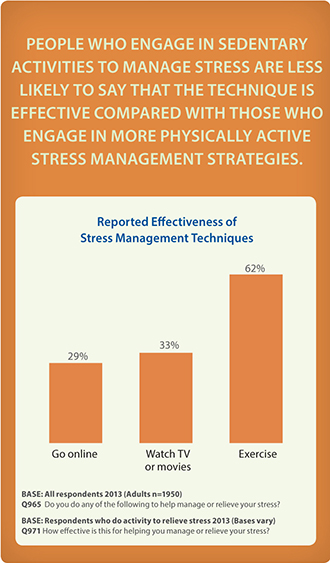
Survey findings testify that Americans spend much of their fourth dimension engaged in sedentary activities — often more than than three hours a day watching TV or going online. Many report turning to these activities to manage their stress. Yet people who appoint in these activities to manage stress are less probable to say that the technique is effective, compared with those who engage in more physically agile stress management strategies.
On boilerplate, adults report that they spend three.9 hours a day watching Telly, iii.7 hours a day going online and three.iv hours a twenty-four hours sitting at a desk.
Xl-two percent of adults written report going online to assist manage stress and forty per centum say they watch TV or movies for more than than two hours a day.
Only 29 percent of those who become online to manage stress and 33 percentage of those who watch TV or movies to manage stress say these techniques are very or extremely constructive. In contrast, amid adults who exercise to manage stress (43 percentage), 62 pct tout its effectiveness.
 Adults who study the highest levels of stress in the by calendar month (eight, nine or ten on a 10-point scale) are less likely to say they do each calendar week and more likely to say they have skipped practice due to stress in the past month. Adults who report experiencing loftier stress are too more likely than adults who report experiencing low stress (1, two or three on the 10-point scale) to appoint in sedentary activities for stress management.
Adults reporting loftier stress levels are less likely than those reporting depression stress levels to say they do at least once weekly (54 pct vs. 64 percent). Furthermore, those who practice less than once a week or not at all study stress levels in the past calendar month higher than those of adults who exercise one time a week or more than (5.three vs. iv.9).
Adults reporting high stress are more than four times equally likely as adults reporting low stress to say they have skipped exercise in the past month due to stress (64 percent vs. fifteen percent).
Adults reporting high stress are more likely to say they appoint in sedentary activities to manage stress. More than half report managing their stress by going online (53 per centum vs. 31 percent of those reporting low stress) and watching TV or movies for more two hours a day (51 per centum vs. 27 percent of those reporting low stress).
Adults reporting loftier stress levels say they spend an boilerplate of 4.4 hours a day online, compared with three.four hours a day for adults reporting low stress levels.
Despite the fact that they report exercising less frequently than those with low stress, adults with high stress appear to be more than aware of the effect that exercise has on their stress level. Among those who practise, 33 percent of loftier-stress adults said they feel less stressed after exercising, compared with 18 percent of depression-stress adults.
Teens also report spending much of their time engaged in sedentary activities, nevertheless say that practise offers more stress relief than other techniques they use to manage stress.
Teens report spending an boilerplate of 3.4 hours a twenty-four hour period sitting at a desk, 2.8 hours a day watching Goggle box and ii.7 hours a day going online.
More teens than adults say their sedentary stress management techniques are effective, simply they still report exercise equally the virtually effective stress management arroyo. Sixty-eight pct of teens who exercise or engage in physical activity to manage stress (37 percent) say information technology is extremely or very effective. Comparatively, 59 percent of teens who report playing video games to manage stress, 41 pct who report going online to manage stress and 39 percent who report watching TV or movies for more than than two hours a day to manage stress say these are very or extremely effective stress management techniques.
Teens who written report exercising at least once weekly report an average stress level in the by month of 4.four on a 10-bespeak calibration, compared with 5.1 among teens who report exercising less than once a week or not at all.
Fifty-fifty more important, teens who report exercising at least once weekly report lower average stress levels during the past school year than teens who report exercising less than once a week or non at all (5.6 vs. 6.four on a x-indicate scale).
Teens who report high stress during the past school year also report spending an average of 3.ii hours online a solar day, compared with 2 hours among those with depression reported stress levels during the past school year.
Despite their fitness goals, Millennials report spending more than time engaging in sedentary activities than other generations. They too spend the about time engaged in screen time to help manage stress.
Millennials study spending an average of v hours a day online, compared with 3.7 hours for Gen Xers, 3.one hours for Boomers and 2.v hours for Matures.
Threescore-8 percent of Millennials say they engage in screen time (including going online, watching TV or movies for more than 2 hours a day, playing video games and sounding off on social media) to assist manage stress, compared with 64 percent of Gen Xers, 59 percent of Boomers and 54 percent of Matures.
Millennials are more likely than other generations to say they nap or sleep to relieve stress — 41 percent of Millennials report this, compared with 33 percent of Gen Xers, 29 percent of Boomers and 20 percent of Matures.
Women struggle with do
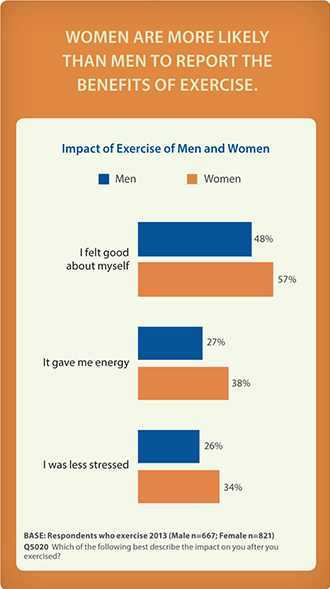 While more than women than men written report positive results of practise, they also written report exercising less frequently. Compared with men, women are more than likely to say they accept skipped exercise in the past month when they were stressed.
Seventy percent of men, compared with 56 percentage of women, say they exercise in one case a week or more.
Women are more likely than men to report the benefits of exercise: 57 per centum of women say exercise makes them feel good about themselves versus 48 percent of men, 38 per centum of women report that practice gives them more than energy versus 27 percent of men, and 34 per centum of women say they are less stressed later on practise versus 26 percent of men.
Despite the positive results of exercise that women report, 43 percent say they have skipped exercise in the by month when stressed, compared with 34 percent of men.
Patterns related to physical activity are also apparent among teen girls and boys. Girls are less likely than boys to say they exercise, play sports to manage their stress and place importance on being physically active or fit.
80-seven percent of boys say they exercise at least one time weekly, compared with 73 percentage of girls.
20-four percentage of girls say they play sports to help manage or salve stress, compared with 32 percentage of teen boys reporting the same.
While the majority of teens (62 percent) think existence physically fit is important, teen boys are more than likely than girls to say that existence physically fit is extremely or very important to them (66 percent vs. 57 percent of teen girls).
Footnotes

Source: https://www.apa.org/news/press/releases/stress/2013/exercise
Posted by: barnescamonwarld1947.blogspot.com
0 Response to "What Comparisons Does Bacon Draw Between Studies And Physical Excercise"
Post a Comment